
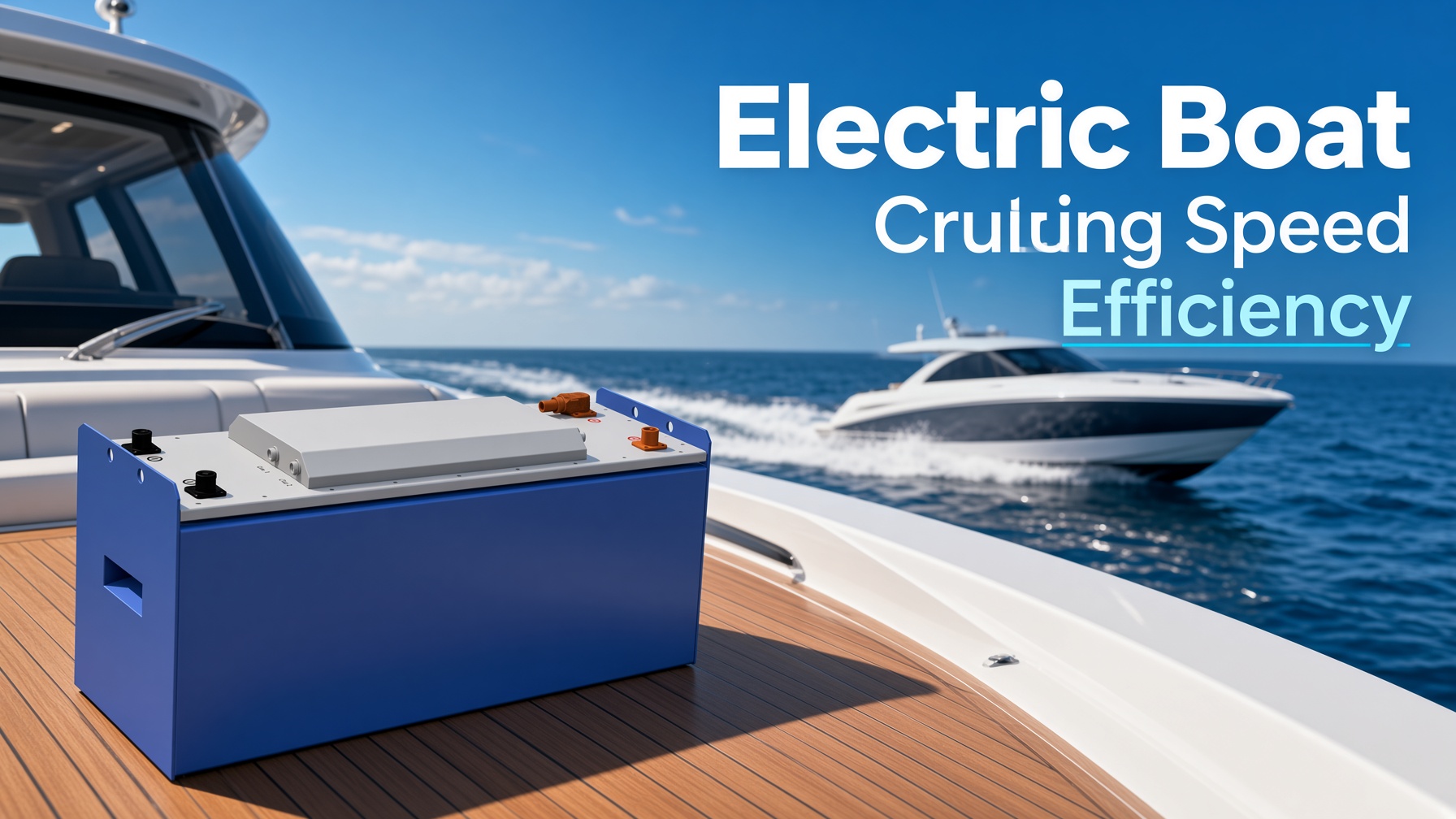
Electric boat cruising speed efficiency determines how far a vessel can travel on a given battery charge and how much energy is required per nautical mile. Unlike combustion engines, electric propulsion delivers near-instant torque and high motor efficiency (typically >90 %), yet hydrodynamic drag rises rapidly with speed. Understanding the relationship between speed, hull form, and energy use is therefore essential for range planning, battery sizing, and total cost of ownership in 2026.
For displacement hulls the propulsive power required scales approximately with the cube of speed. Doubling speed multiplies energy demand by roughly eight. Planing and especially hydrofoil designs alter this curve, creating efficiency sweet spots that conventional monohulls cannot match. Real-world data from production vessels confirm that careful selection of cruising speed yields the largest gains in electric boat cruising speed efficiency.
Physics Governing Speed and Energy Use
Hydrodynamic resistance consists of frictional, wave-making, and residual drag. Below hull speed, wave-making drag grows steeply; above hull speed a planing hull can reduce wave drag but must overcome high frictional and spray resistance. Hydrofoils lift the hull clear of the water once takeoff speed is reached, cutting total drag by 70–80 % in many cases.
Key quantitative relationships observed in 2026 testing:
- Displacement vessels: most efficient at 50–60 % of theoretical hull speed.
- Semi-displacement and planing hulls: efficiency often peaks just after the planing threshold.
- Foiling vessels: peak efficiency typically occurs at the design foiling speed (commonly 18–25 kn).
Battery chemistry further influences sustained efficiency. Lithium iron phosphate (LiFePO₄ / LFP) cells offer stable voltage under load, long cycle life (≥3,500–5,000 cycles at 80 % depth of discharge), and superior thermal safety compared with high-nickel chemistries. These characteristics support consistent electric boat cruising speed efficiency across multi-hour runs.
Measured Performance at Practical Cruising Speeds
The following table summarises published and field-verified consumption figures for representative vessels operating at their preferred cruising speeds.
| Vessel / Hull Type | Cruising Speed | Approx. Consumption | Example Battery | Approx. Range | Σημειώσεις |
|---|---|---|---|---|---|
| Candela C-8 (hydrofoil) | 22 kn | 0.8–1.2 kWh/nm | 69 kWh | 57 nm | Foiling; drag reduced ~80 % |
| Ribcraft PRO 480 + RAD 40 | 12–16 kn | 1.53–1.83 kWh/nm | 21 kWh | — | Optimal endurance band |
| Typical planing dayboat | 20–25 kn | 3–6+ kWh/nm | 80–120 kWh | 20–40 nm | High spray & frictional drag |
| Displacement / semi-displacement | 5–8 kn | 0.5–1.5 kWh/nm | 20–50 kWh | 30–80+ nm | Lowest power demand |
| High-speed RIB (surface drive) | 30 kn | ~4 kWh/nm | 105 kWh | ~26 nm | Advanced propulsion |
These figures illustrate why electric boat cruising speed efficiency varies by more than an order of magnitude across hull types. A hydrofoil craft can deliver useful coastal range from a relatively modest battery, while a conventional planing hull of similar size often requires two to three times the energy capacity for comparable distance.
Hull Design and Propulsion Choices That Improve Efficiency
Hull form remains the dominant variable. Carbon-fibre construction reduces displacement, lowering the power needed to reach and maintain foiling or planing speeds. Surface-piercing propellers or specialised electric pods can raise propulsive efficiency to 65–70 % at higher speeds, compared with 55–60 % for conventional submerged propellers.
Motor and controller efficiency also matter. Modern permanent-magnet motors exceed 95 % peak efficiency; paired with high-voltage battery systems (400–800 V class) they reduce current, cable losses, and heat generation. Opportunity charging during short stops (adding 15–40 % capacity) further extends effective daily range without requiring full overnight charges.
State-of-charge management is equally critical. Sustained operation between 20 % and 30 % minimum SOC, avoiding deep discharges, maximises both cycle life and available power under high-load conditions. Integrated BMS systems that continuously monitor cell voltage, temperature, and current are mandatory under current marine standards.
Standards and Safety Frameworks Supporting Efficient Operation
Two primary standards govern lithium-ion installations on small craft in 2026:
- ISO 23625:2025 – Small craft — Lithium-ion batteries. Specifies selection, installation, and manufacturer safety information for systems above 500 Wh. Requires compliance with IEC 62619 and IEC 62620 cell/module standards.
- ABYC E-13 (2025 revision) – Lithium Ion Batteries. Mandates a functional BMS with automatic disconnect, audible/visual warnings, and prohibition of bypass connections. Applies to installations above 500 Wh.
Compliance with these standards ensures that the battery system can deliver the power profile required for efficient cruising without thermal or electrical faults that would force speed reductions or early shutdowns.
Practical Checklist for Maximising Electric Boat Cruising Speed Efficiency
- Match hull type to primary mission: foiling for medium-to-high speed coastal work; displacement for long-range low-speed cruising.
- Size battery capacity for the target range at the intended cruising speed, applying a 1.15–1.25× factor for reserve and degradation.
- Specify LFP chemistry with documented ≥3,500 cycles at 80 % DoD and integrated BMS meeting ISO 23625 / ABYC E-13.
- Target continuous operation above 20–30 % SOC; use opportunity charging of 15–40 % capacity during stops.
- Verify propeller or foil design efficiency at the chosen cruising speed through manufacturer data or independent sea trials.
- Confirm high-voltage system architecture (where applicable) to minimise I²R losses at higher power levels.
- Install accurate real-time monitoring of speed, power, and remaining range (GPS-linked BMS or dedicated display).
- Plan routes that keep the vessel in its hydrodynamic sweet spot for the majority of the distance.
Συχνές ερωτήσεις
What is the most efficient cruising speed for a typical electric displacement boat? Generally 50–60 % of theoretical hull speed. Beyond this point wave-making drag rises sharply and range falls rapidly.
How much more efficient are hydrofoils than planing hulls? Field data show 60–80 % lower energy consumption at comparable speeds once the vessel is fully foiling, provided the foils are clean and correctly trimmed.
Does higher battery voltage improve electric boat cruising speed efficiency? Yes. Higher system voltage reduces current for a given power level, lowering resistive losses in cables, connectors, and the motor controller.
How should SOC be managed during a long cruise? Keep minimum SOC above 20–30 %. Short opportunity charges that restore 15–40 % capacity are preferable to deep cycling.
Which standards should a buyer verify on a new electric boat? ISO 23625:2025 for the battery system itself and ABYC E-13 for installation and BMS functionality. Both are now widely referenced by OEMs and classification societies.
Decision Framework
When evaluating electric boat cruising speed efficiency for a specific application, apply the following sequence:
- Define the primary operating speed band and required range at that speed.
- Select the hull form that minimises resistance in that band (foiling, planing, or displacement).
- Calculate required usable energy using verified kWh/nm figures, then size the LFP pack with appropriate margins.
- Confirm the complete system meets ISO 23625:2025 and ABYC E-13, including BMS protection and thermal management.
- Validate real-world consumption through sea trials or independent test data rather than relying solely on brochure claims.
- Factor opportunity charging infrastructure and expected daily duty cycle into the final capacity decision.
Operators who follow this framework consistently achieve the best combination of range, battery longevity, and operating cost. In 2026 the technology exists to deliver practical, efficient electric propulsion across a wide range of recreational and light commercial vessels; the decisive factor is matching speed, hull, and battery system with precision.
Authoritative References
- Candela C-8 official specifications and range data: https://candela.com/leisure-boats/candela-c-8/
- ISO 23625:2025 – Small craft — Lithium-ion batteries: https://www.iso.org/standard/85220.html
- ABYC E-13 Lithium Ion Batteries (2025 revision): https://webstore.ansi.org/standards/abyc/abyc132025
- Ribcraft PRO 480 Electric performance data (2026): https://www.ribcraft.com/uk/news/ribcraft-unveils-the-pro-480-electric-a-strategic-leap-powered-by-rad-propulsions-40-kw-drive-system
- Torqeedo Deep Blue range and efficiency guidance: https://www.torqeedo.com/
- IEC 62619 secondary cells and batteries for industrial applications (referenced by ISO 23625)