
Electric boat motors are not one product class. They differ by mounting architecture, voltage, continuous versus peak power, cooling method, and the electrical machine inside the housing. Different Types of Electric Boat Motors Explained is a specification task: the wrong architecture wastes energy, complicates service, or forces an oversized battery. The right one matches hull type, duty cycle, and the 2026 installation rules in ISO 16315:2026, ISO 23625:2025 and ABYC E-30.
This briefing classifies the motors used on small craft in 2026, compares real product families, and gives selection criteria for builders, surveyors, and owners.
Table of Contents
- How Electric Boat Motors Are Classified
- Trolling Motors
- Portable and Separate-Battery Outboards
- Inboard Shaft Motors
- Saildrives
- Pod Drives and Foil-Integrated Pods
- Electrical Machine Types Inside the Housing
- Voltage, Current and Battery Matching
- Standards That Govern a 2026 Installation
- 2026 Product Comparison
- Decision Checklist
- Συχνές ερωτήσεις
- Decision Framework
- Authoritative References
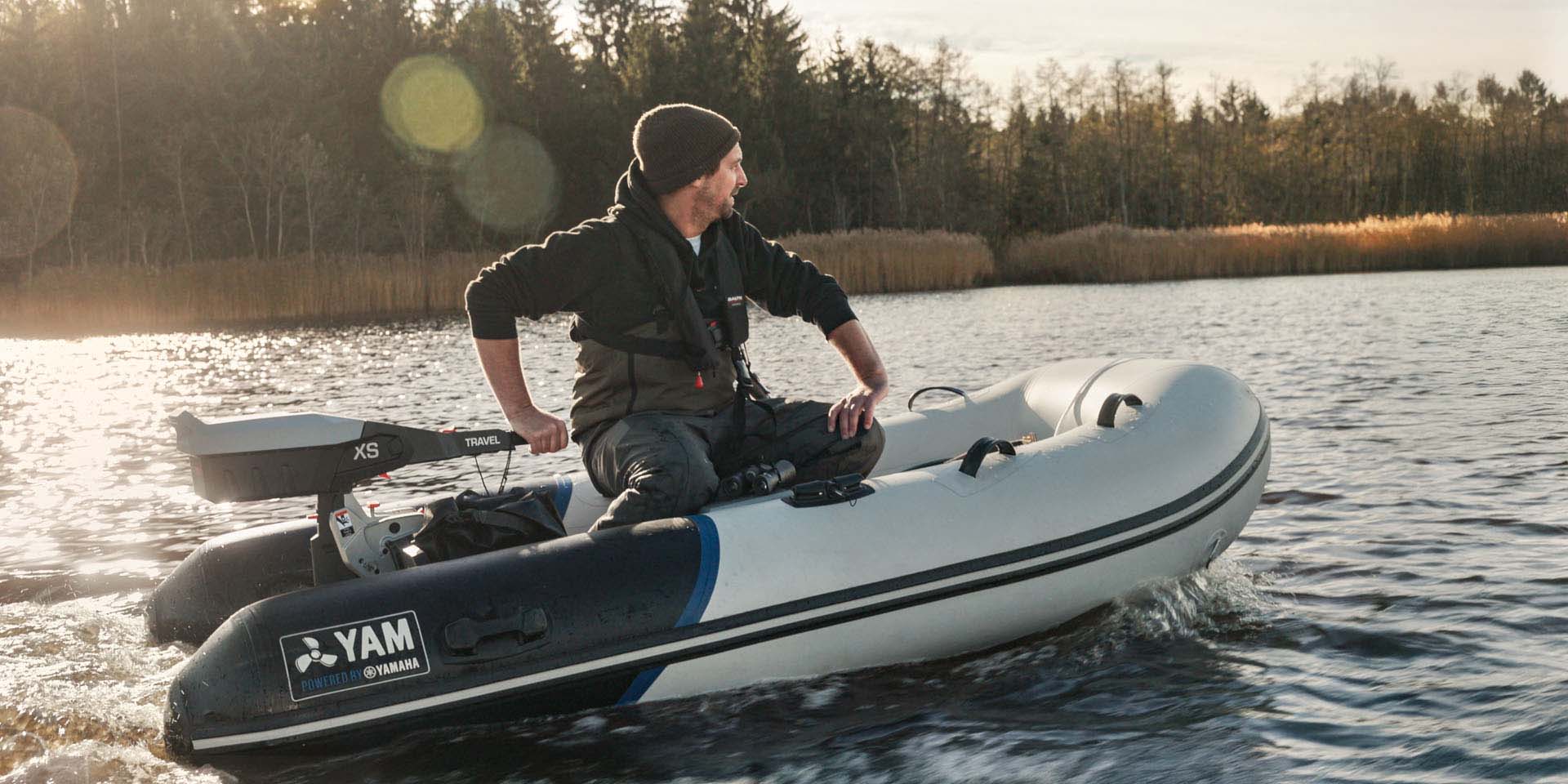
Portable electric outboard on a tender – the 0.5–3 kW integrated-battery class used on inflatables, dinghies and daysailers.
How Electric Boat Motors Are Classified
Buyers should separate two questions:
- Where does the motor sit? Outboard, trolling motor, inboard shaft, saildrive, or pod.
- What machine is inside? Brushed DC, brushless DC (BLDC), permanent-magnet synchronous (PMSM), induction, or transverse-flux.
Architecture decides installation cost, service access, and drag. Machine type decides efficiency, noise, torque density, and cooling. Both must be specified together.
| Architecture | Typical power | Typical voltage | Best fit | Main trade-off |
|---|---|---|---|---|
| Bow / transom trolling motor | 0.3–1.5 kW class (lb-thrust ratings) | 12 / 24 / 36 V | Fishing boats, precise low-speed hold | Not a cruise motor; high-rpm small prop |
| Portable outboard (integrated battery) | 0.5–3 kW | 24–48 V | Tenders, dinghies, daysailers | Energy is limited by the onboard pack |
| Separate-battery outboard | 3–40+ kW | 48–96 V, then high-voltage | RIBs, workboats, cruising sailboats | Cabling, BMS matching, and charger design required |
| Inboard shaft | 10–150+ kW | 48–400 V+ | Displacement cruisers, conversions | Quiet and protected; engine-room access needed |
| Saildrive | 5–30 kW typical | 48–96 V | Production sailboats replacing a diesel saildrive | Hull penetration; folding prop under sail |
| Fixed or steerable pod | 1–80+ kW (leisure); higher on ferries | 48–400 V | Sailboats, cats, passenger craft | Low noise and appendage drag; yard installation |
| Hydrofoil-integrated pod | 45–160 kW per unit | ~350 V class and above | High-speed leisure and passenger foilers | Lowest drag when foiling; flight-control complexity |
Outboards still account for the largest share of motors sold for electric boats. Pods are the fastest-growing architecture. That split is why Different Types of Electric Boat Motors Explained starts with mounting, not marketing horsepower-equivalents.
Trolling Motors
Trolling motors are low-speed positioning drives, not primary propulsion for a cruise. They are rated in pounds of static thrust rather than continuous kilowatts. 2026 retail lines remain clustered at 12 V, 24 V and 36 V. Newer units are brushless; older designs still use brushed DC.
Typical 2026 facts:
- Voltage steps with boat weight and current. A 36 V unit is the practical ceiling for most recreational trolling setups.
- GPS-guided models (spot-lock, route follow) now dominate the mid-to-upper range.
- Props are small-diameter and high-rpm. They are not interchangeable with outboard or pod props.
Use a trolling motor when the mission is hold-and-creep. Do not treat it as a substitute for a 2–6 kW cruise outboard.
Portable and Separate-Battery Outboards
An outboard hangs on the transom. Service is simple: tilt it, unbolt it, or swap it. That is why outboards remain the default for tenders and small powerboats.
Portable (integrated-battery) class, 0.5–3 kW
- ePropulsion eLite – 500 W nominal / 750 W sport for kayaks, SUPs and inflatables; 378 Wh, 25.2 V integrated pack.
- ePropulsion kLite 750 (2026) – kayak-specific outboard: 500 W continuous / 750 W boost, 6.5 kg motor with a 378 Wh integrated pack, IP67.
- ePropulsion Spirit 1.0 Plus / Evo – 1 kW with a 1,276 Wh pack.
- ePropulsion Spirit 2 (2026) – 2 kW continuous, 3 kW boost on the tiller version, 1,539 Wh Spirit Battery Ultra (lithium-ion, ~1,000 cycles at 80 % SoH), hydrogeneration up to ~380 W at 10 kn.
- Mercury Avator 7.5e – 750 W at the prop shaft, 48 V, integrated 1,030 Wh pack, transverse-flux machine.
- Torqeedo Travel family – portable class from the Travel XS up to Travel XP. Travel XP delivers 1,600 W (5 HP-equivalent thrust) from a 12.6 kg motor and a 1,080 Wh IP67 lithium pack; it is the top integrated-battery unit in the 2026 Travel line for boats up to about 2 tons.
Separate-battery class, 3–40 kW and above
- ePropulsion Navy 3.0 / 6.0 Evo – 3 kW and 6 kW at 39–60 V input. Navy 6.0 Evo draws ~125 A at 48 V full power; the recommended E163 LFP pack is 51.2 V / 163 Ah / 8.345 kWh with 150 A continuous discharge.
- ePropulsion X-Series – 12 / 20 / 40 kW outboards at 96 V DC. The 40 kW unit is closed-loop liquid-cooled; 12 kW and 20 kW units use natural cooling.
- Torqeedo Cruise – 2–10 kW class on 48 V Power-series batteries with TorqLink.
- Torqeedo Deep Blue – 25–100 kW high-voltage outboards paired with Deep Blue Battery 40 (38 kWh NMC) or Battery 80 (79.2 kWh nominal / 77.6 kWh usable LFP at 348 V).
- Mercury Avator 20e / 35e – 2,200 W and 3,700 W prop-shaft power at 48 V; modular 2,300 Wh NMC packs, up to four in parallel through a Power Center.
- Mercury Avator 75e / 110e – 7.5 kW and 11 kW prop-shaft power at 48 V; remote 5,376 Wh LFP packs (51.2 V, 105 A continuous each, IP67), minimum two packs, up to four through the 5400 Power Center. Input power is 8.6 kW and 12.8 kW respectively.
ePropulsion Spirit 2 – a 2 kW portable outboard with an integrated 1,539 Wh pack and hydrogeneration.

48 V separate-battery electric outboard on a RIB – modular packs on the transom, typical of the 2–11 kW Avator and Navy class.
Above roughly 10 kW, 48 V current becomes large. A 20 kW load at 48 V exceeds 400 A. Mercury’s 110e still stays at 48 V by paralleling LFP packs (two to four × 105 A continuous), but cable, connector and Power Center design become the limiting items. That is the point at which 96 V or 300–400 V outboards stop being optional for most yards.
Inboard Shaft Motors
An inboard sits in the engine room and drives a conventional shaft and propeller. The layout is familiar to any yard that has aligned a diesel. It protects the machine from spray, keeps weight low in the hull, and accepts large continuous ratings.
2026 examples:
- ePropulsion I-Series – 10 / 20 / 40 kW inboards with the same eSSA control stack used on the X-Series outboards.
- Torqeedo Deep Blue inboard variants in the 25–100 kW band.
- Conversion kits in the 7.5–20 kW band used on classic daysailers (Mastervolt / DriveMaster-class installations remain a common reference).
Inboards suit displacement hulls, motorsailers, and any retrofit that already has a shaft log. They are the wrong first choice for a trailer boat that needs the motor off the water for beaching.
Saildrives
A saildrive drops through the hull like a diesel saildrive. The electric version keeps the same footprint so a production sailboat can swap the combustion unit without a new aperture.
Typical power is 5–30 kW. Folding or feathering props cut drag under sail. Some 2026 units rotate 360° and double as a stern thruster. Installation is a yard job: alignment, bonding, and ISO 16315:2026 overcurrent protection all have to be documented.
Pod Drives and Foil-Integrated Pods
A pod puts the motor in the water, usually with no gearbox. Seawater cools the housing. Noise and mechanical loss fall. Cabin volume rises because there is no engine box.
Leisure and cruising pods
- ePropulsion Pod Drive Evo – 1 / 3 / 6 kW direct-drive units for small sailboats.
- ePropulsion Pod Drive eSSA – 12 kW (31 kg) and 20 kW (53 kg) at 96 V DC; natural-cooled motor, folding-prop option on the 12 kW unit.
- Torqeedo Cruise and Deep Blue pods covering the mid and high-voltage bands.
- Fixed and steerable pods from specialists such as E-Tech, Vetus E-POD and Rim Drive Technology.
Hydrofoil-integrated pods
Candela’s C-Pod is the production reference for high-speed foilers. Permanent-magnet motors sit in a submerged housing and drive contra-rotating propellers with no gearbox. On the C-8 the C-Pod is specified at 45 kW continuous / 50 kW peak with a ~350 V, 69 kWh pack, delivering 57 NM at 22 kn. The P-12 Business uses dual larger C-Pods (110 kW continuous / 160 kW peak each) with 378 kWh nominal / 336 kWh usable energy.
Foiling cuts energy use by up to 80 % versus a conventional planing hull. That gain only appears if the motor, foil, and flight controller are designed as one system. A generic leisure pod will not reproduce it.
Electric pod drive – a submerged motor and propeller that keeps noise and appendage drag low on sailboats and displacement craft.
Electrical Machine Types Inside the Housing
Architecture is what the owner sees. The machine type is what sets efficiency and thermal behaviour.
| Machine type | Where it is used in 2026 | Strengths | Limits |
|---|---|---|---|
| Brushed DC | Legacy trolling motors | Cheap, simple speed control | Brush wear, lower efficiency, more noise |
| BLDC (brushless DC) | Most portable and mid-power outboards | High efficiency, low maintenance, compact | Controller quality and cooling decide continuous rating |
| PMSM (permanent-magnet synchronous) | Pods, high-voltage outboards, foil drives | Highest torque density and efficiency (typically 85–95 % motor) | Magnet cost; needs a capable inverter |
| Induction (asynchronous) | Some inboards and commercial pods | Robust, no rotor magnets | Heavier and less efficient at part load |
| Transverse-flux | Mercury Avator family | High torque at low rpm; allows a larger, slower prop | Proprietary architecture; limited third-party ecosystem |
Direct-drive PMSM and BLDC units dominate new 2026 catalogues because they deliver peak torque from zero rpm and allow a larger, slower propeller. Combustion outboards reach peak torque only in a narrow rpm band and lose shaft power in the lower-unit gears. That is why a 6 kW electric outboard can feel stronger at the dock than its “9.9 hp equivalent” label suggests.
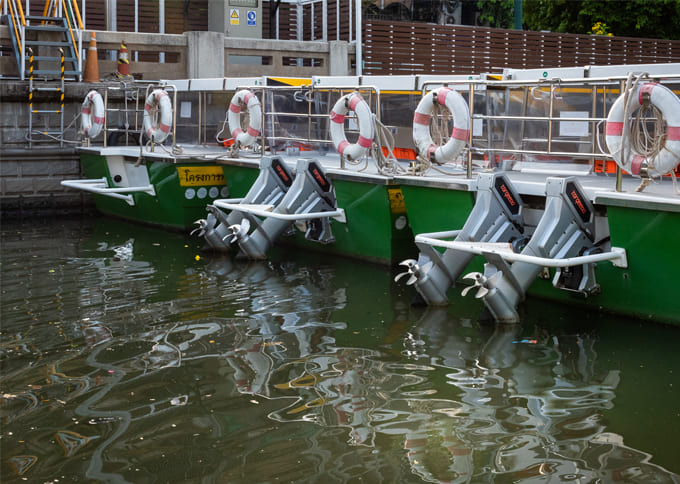
Separate-battery electric outboards on workboats – the powerhead houses the machine and controller; energy stays in hull or deck packs.
Voltage, Current and Battery Matching
Power identity:
P = V \times I
A 6 kW motor at 48 V draws 125 A continuous. The same 6 kW at 96 V draws 62.5 A. Higher voltage cuts I²R losses, cable size and connector heating.
Matching rules that do not change with architecture:
- Battery nominal and operating window must sit inside the controller’s accepted range.
- Battery continuous discharge rating must exceed full-power motor current with margin. Peak rating must cover acceleration and prop-load spikes.
- Size usable energy from average—not peak—power:
\text{Required usable kWh} = \text{Average power (kW)} \times \text{Runtime (h)} \times 1.15
Keep a 15 % reserve for temperature, ageing and hotel loads. Design the duty cycle around 15–40 % opportunity charging and keep state of charge (SOC) above 20–30 % for cycle life.
LiFePO₄ (LFP) is the default propulsion chemistry in 2026. Quality marine LFP delivers ≥3,500–5,000 cycles at 80 % depth of discharge. Torqeedo rates the Deep Blue Battery 80 at ≥3,750 cycles at 80 % DoD (or 4,000 cycles at 75 % DoD) with IEC 62619 / IEC 62620 compliance, an IP67 enclosure and a 10-year capacity warranty. NMC remains in some high-energy-density packs (Deep Blue Battery 40, Candela / Polestar C-8 pack, Spirit Battery Ultra) where volume is tighter and thermal management is more demanding.
Sealed marine LiFePO₄ pack – enclosure rating and BMS protection must match the motor’s continuous current and the saltwater environment.
Systems at or above 60 V DC fall outside the basic safety envelope of ISO 23625:2025 and require additional manufacturer and installation measures. High-voltage Deep Blue and C-Pod installations are in that category.
Standards That Govern a 2026 Installation
| Πρότυπο | Scope | Practical effect |
|---|---|---|
| ISO 16315:2026 | Electrical systems used for electrical propulsion and hybrid electrical parts; craft ≤24 m; DC <1,500 V, AC ≤1,000 V | Design and installation of the propulsion electrical system; second edition published February 2026; clarifies overcurrent protection and isolated-DC fault monitoring |
| ISO 23625:2025 | Lithium-ion batteries >500 Wh on small craft | Selection, installation, manufacturer safety information; references IEC 62619 and IEC 62620; audible pre-alarm before propulsion disconnect |
| ABYC E-30 | Electric propulsion systems (North America) | Design, construction and installation of AC/DC propulsion systems above the E-11 voltage thresholds |
| ABYC E-13 (2025) | Lithium-ion batteries >500 Wh on boats | BMS, system design, installation; first full revision of the 2022 edition |
Companion rules: ISO 13297 for AC/DC house wiring, ABYC E-11 for North American electrical systems, IEC 62619 / IEC 62620 for industrial cell safety and performance.
2026 Product Comparison
| System | Architecture | Motor rating | Voltage / energy | Documented note |
|---|---|---|---|---|
| ePropulsion kLite 750 | Kayak portable outboard | 500 W cont. / 750 W boost | 378 Wh / 25.2 V integrated | IP67; 6.5 kg motor |
| Torqeedo Travel XP | Portable outboard | 1.6 kW | 1,080 Wh integrated Li-ion | 5 HP-eq thrust; 12.6 kg motor; IP67 pack |
| ePropulsion Spirit 2 | Portable outboard | 2 kW cont. / 3 kW boost | 1,539 Wh integrated Li-ion | Hydrogeneration ~380 W at 10 kn |
| ePropulsion Navy 6.0 Evo | Separate-battery outboard | 6 kW | 39–60 V; E163 LFP 8.345 kWh recommended | ~125 A at full power; 150 A pack continuous |
| Mercury Avator 20e / 35e | Separate-battery outboard | 2.2 / 3.7 kW at prop shaft | 48 V; modular 2.3 kWh NMC packs | Transverse-flux; 5 hp / 9.9 hp acceleration class |
| Mercury Avator 75e / 110e | Separate-battery outboard | 7.5 / 11 kW at prop shaft | 48 V; 5.376 kWh LFP packs (min. 2, max. 4) | Transverse-flux; 51.2 V / 105 A continuous per pack; IP67 |
| ePropulsion X-Series | Separate-battery outboard | 12 / 20 / 40 kW | 96 V DC | 40 kW liquid-cooled; 12/20 kW naturally cooled |
| Torqeedo Deep Blue | HV outboard or inboard | 25–100 kW | 348 V / 79.2 kWh nom. LFP (Battery 80) | 79 kW continuous discharge; ≥3,750 cycles @ 80 % DoD |
| ePropulsion Pod eSSA | Pod | 12 / 20 kW | 96 V DC | 31 kg / 53 kg; folding prop option on 12 kW |
| Candela C-8 C-Pod | Foil-integrated pod | 45 / 50 kW | ~350 V / 69 kWh | 57 NM @ 22 kn; DC 10–80 % <30 min |
| Candela P-12 Business | Dual foil pods | 110 / 160 kW each | 378 kWh nom. / 336 kWh usable | Foiling cuts energy use up to 80 % |

Candela C-8 – foil-integrated C-Pod architecture, the high-speed end of the 2026 electric-motor range.
Decision Checklist
- Write the mission first: hull type, target speed, payload, and hours at average power.
- Choose architecture from the table before choosing a brand.
- Confirm controller voltage window and continuous / peak current against the battery continuous discharge rating plus margin.
- Specify LFP unless a documented energy-density constraint requires NMC with upgraded thermal management.
- Size usable kWh from average power × mission time × 1.15; plan 15–40 % opportunity charging and a 20–30 % SOC floor.
- Require a BMS with cell-level monitoring and a helm-audible/visual pre-alarm before propulsion disconnect.
- Demand IP67 (or better) for packs and connectors exposed to spray or immersion.
- Document compliance with ISO 16315:2026, ISO 23625:2025 and, where applicable, ABYC E-13 / E-30.
- Record the communication protocol (CAN, TorqLink, proprietary) so remaining-range display is trustworthy.
- For pods and saildrives, budget yard time for alignment, bonding and sea-trial current measurements.
Συχνές ερωτήσεις
Is a trolling motor the same as a small electric outboard? No. Trolling motors are low-speed positioning devices on 12–36 V with small high-rpm props. Cruise outboards are rated in continuous kilowatts and designed for transit.
When should I move from 48 V to high voltage? Above about 10 kW. At 48 V a 20 kW load exceeds 400 A. 96 V or 300–400 V systems cut cable size, connector heating and I²R loss.
Do I need the same brand of motor and battery? Native communication and a validated discharge map simplify commissioning and protect warranty. Third-party LFP packs work if voltage, continuous current, chemistry and cut-off behaviour are proven; range-display accuracy usually falls.
Which motor type is most efficient? Direct-drive PMSM and quality BLDC units typically convert 85–95 % of electrical input to shaft power. Architecture still matters: a foil-integrated pod on a flying hull uses far fewer kilowatt-hours per nautical mile than the same machine on a planing hull.
Which standard applies first? ISO 16315:2026 covers the propulsion electrical system. ISO 23625:2025 covers the lithium battery. Both apply together on electric and hybrid craft under 24 m. North American installations add ABYC E-30 and E-13.
Decision Framework
Applying Different Types of Electric Boat Motors Explained to a specification follows six steps:
- Define the mission: hull type, target speed, payload, and required endurance at average—not peak—power.
- Select architecture (trolling motor, portable outboard, separate-battery outboard, inboard, saildrive, pod, or foil-integrated pod) from the comparison table.
- Fix system voltage from motor power so continuous current stays inside practical cable and connector limits.
- Size usable kWh with a 15 % reserve and an operating band that supports 15–40 % opportunity charging above 20–30 % SOC.
- Specify LFP with documented ≥3,500-cycle life at 80 % DoD, IP67 protection, and BMS pre-alarm—unless a documented energy-density case requires NMC.
- Close the installation against ISO 16315:2026, ISO 23625:2025 and ABYC E-13 / E-30, then commission under load to confirm no unexpected BMS disconnect.
Different Types of Electric Boat Motors Explained exists because mounting, voltage and machine type are not interchangeable. A portable 2 kW outboard, a 48 V Navy-class cruise motor, a 96 V pod and a 350 V foil drive can all be “electric,” yet they impose different cables, batteries, survey requirements and running costs. Match the architecture to the hull, then lock voltage, continuous current and chemistry so the motor delivers its rated range instead of a mid-voyage cut-out.
Authoritative References
- ISO 16315:2026 – Small craft — Electrical systems used for electrical propulsion: https://www.iso.org/standard/84203.html
- ISO 23625:2025 – Small craft — Lithium-ion batteries: https://www.iso.org/standard/85220.html
- ABYC E-13-2025 – Lithium Ion Batteries: https://webstore.ansi.org/standards/abyc/abyc132025
- ABYC 65th supplement announcement (E-11 and E-13 updates, August 2025): https://abycinc.org/news/supplement65/
- IEC 62619:2022 – Safety requirements for secondary lithium cells and batteries for industrial applications: https://webstore.iec.ch/en/publication/64073
- Blue Marine – Pod Drive vs Outboard vs Inboard (10 July 2026): https://bluemarine.com/blogs/news/pod-drive-vs-outboard-vs-inboard-which-electric-propulsion-is-right
- Mercury Marine – Avator 20e / 35e: https://www.mercurymarine.com/us/en/engines/electric/avator/avator-20-35e
- Mercury Marine – Avator 75e / 110e: https://www.mercurymarine.com/us/en/engines/electric/avator/avator-75-110e
- Mercury extends Avator lineup with 20e and 35e: https://michianaoutdoorsnews.com/gear/boating-gear/4022-mercury-extends-all-electric-outboard-lineup-with-two-larger-models