
How Li-ion Forklift Performance Is Measured
Three numbers are routinely mixed, and that mixing is why two quotes for the same truck can look a decade apart.
Throughput. Pallet moves per hour, cases per hour, or tonnes per hour. This is what the warehouse buys. Raymond’s customer-site comparison, conducted with NYSERDA support, recorded 21 pallet moves per hour on the lithium truck versus 18 on the lead-acid truck over a five-week, ~4,000-pallet window—a 17% difference attributed to constant power through the discharge.
Energy intensity. kWh per operating hour. Compact warehouse trucks often sit well below 2 kWh/h on a VDI cycle; 1.5–3 t counterbalance trucks commonly sit in a 4–8 kWh/h band depending on lift height, attachments, and ramps. Size the pack from measured kWh/h, not from a brochure “eight-hour shift” claim.
Available power under load. Lift speed and travel speed at a stated SOC. LFP holds voltage flatter than flooded lead-acid, so hydraulic speed does not collapse in the last third of the shift. That is the mechanism behind the move-rate gain. It disappears if the pack is undersized for peak lift current, if connectors add resistance, or if the BMS throttles for temperature.
Convert the vendor’s cycle rating into your hours before you sign. Example: 3,500 cycles × 80% of a 36 kWh pack ≈ 100,800 kWh of throughput to the 80% capacity point. Divide by your measured kWh per operating hour and you have a planning life in hours, not a slogan.
A documented multi-shift proof point is the factory-integrated Linde E18 that passed 32,000 operating hours in continuous three-shift dairy service. At the audit the pack had completed about 1,618 equivalent full cycles against an expected ~4,000-cycle life to 80% residual capacity. Hours and cycles are not the same ledger. Opportunity charging is why that truck could work a decade of shifts without burning the cycle budget.
Application Map: What Changes When the Floor Changes
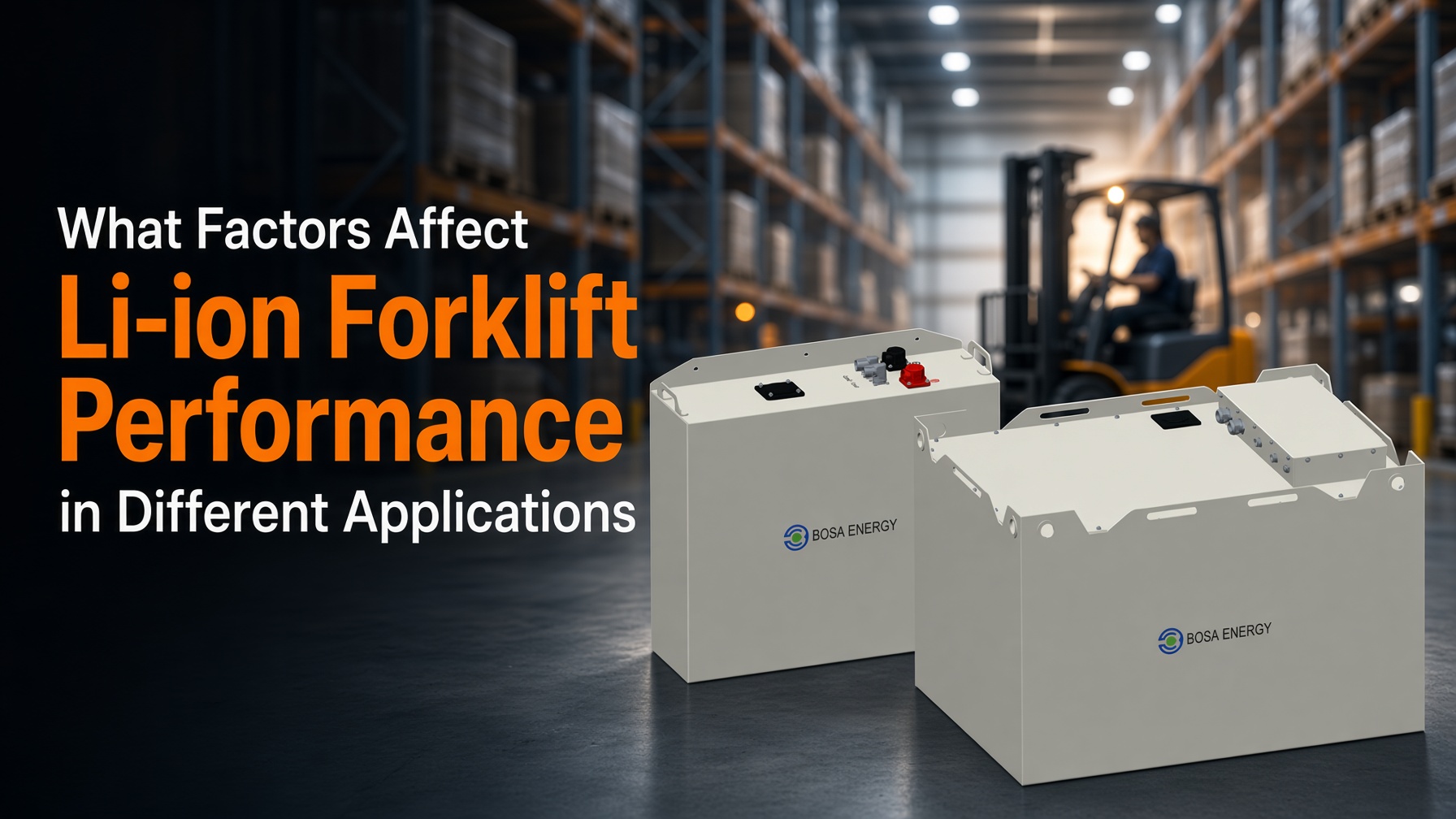
What Factors Affect Li-ion Forklift Performance in Different Applications? depends first on which application you are actually running. The same LFP cell can be the right or wrong purchase depending on the floor.
| Application | Dominant load | What usually fails first | Spec priority |
|---|---|---|---|
| Single-shift indoor warehouse | Travel + mid-height lift | Over-specified pack cost; unused opportunity plugs | Right-size kWh; UL 2580 / IEC 62619; matched charger |
| Multi-shift DC / 3PL / grocery | High hours, frequent lift, short breaks | Connectors, SOC floor violations, unmatched chargers | Opportunity-charge layout; 15–40% adds; 20–30% SOC floor; telematics |
| Cold storage / freezer | Capacity fade + charge lockout | Unheated pack; charging below 0 °C; condensation on connectors | Heated modules; charge-temperature interlock; IP rating; Crown / Toyota-style cold-store kit |
| Outdoor yard / lumber / metals | High C-rate, ramps, weather | Undersized Ah, water ingress, chassis not built for the surface | High-voltage integrated pack; IPX4+; pneumatic chassis (e.g. Hyster XTLG); thermal management |
| Manufacturing / heavy attachments | Peak current on clamps, rotators, high lifts | Voltage sag at peak; heat in the pack | Continuous and 5-second current ratings; ballast / min-weight; BMS current limit documented |
| Mixed dock + freezer | Thermal cycling | Charge refusal after a cold dwell; operator workarounds | Heater strategy + designated warm charge alcove if the pack cannot charge in-zone |
Do not buy one pack SKU for every aisle. A freezer truck that must charge at −25 °C needs a heater and a BMS that will allow charge only inside the published window. An outdoor 11,000–15,500 lb class truck needs a chassis and ingress rating first; chemistry second. Hyster’s XTLG series, launched in the Americas in 2026 on an ICE chassis with integrated LFP, is the current example of that outdoor constraint: VDI testing is cited at about 75% less energy than a comparable diesel, with IPX4 water resistance and side-port charging with motion interlock.
The Factors That Actually Move Output
Rank the variables by how often they cut a shift short in 2026 fleets.
| Factor | Effect on output | Effect on life | Control |
|---|---|---|---|
| Duty cycle (hours, shifts, idle vs work) | Sets required kWh and charger count | Converts cycles into calendar years | Measure hours and kWh/h; size 1.1–1.2× daily demand |
| Load mass, lift height, attachments | Lifting is the expensive work; ramps add travel current | High C-rate raises cell temperature | Publish continuous and peak current; reject undersized Ah |
| Temperature (ambient and cell) | Cold cuts available capacity; heat triggers BMS throttle | Heat accelerates fade; cold charging risks plating | Heater or cooler as specified; charge only in the published band |
| Charging protocol and SOC band | Opportunity charging keeps the truck in the voltage plateau | Deep cycles and 0–10% parking spend life | 15–40% adds; 20–30% SOC floor; weekly balance charge if required |
| Chemistry and listing | LFP holds voltage and thermal margin; NMC trades energy density | Cycle rating is chemistry- and DoD-specific | Demand the test condition, not only the headline |
| Charger–BMS handshake | Wrong charger over-voltage, under-current, or skips balance | Cell drift and early cutoff | Factory or listed matched charger only |
| Connectors, cables, isolation | Resistance looks like a dying pack | Heat at the pin; isolation faults take the truck out | Shift inspection; damaged-pack isolation |
| Operator and layout | Long deadhead, high travel speed, ignored alarms | Abuse that the BMS cannot prevent | Telematics; aisle plugs where the truck already stops |
Voltage sag is the performance mechanism most buyers under-specify. Lead-acid voltage falls as acid is consumed; the operator “nurses” the truck after lunch. LFP holds usable voltage across most of the working SOC window. That is why Raymond recorded 21 versus 18 moves per hour and why a lithium truck that is run into BMS cutoff every afternoon will look no better than the flooded pack it replaced.
Duty Cycle, Load, and Energy Per Hour
Duty cycle is the first filter. A truck at 1,200 hours per year and a truck at 3,600 hours per year are not the same purchase.
- Single-shift, low travel, no attachments: energy intensity is low. A modest LFP pack with overnight charge can be enough. Lead-acid can still win on a three-year cash view if the battery room is already paid for.
- Two- or three-shift DC work: the pack stays in the truck. Opportunity charging during breaks is the design intent. The Linde E18 dairy case at ~3,600 hours per year is the planning reference, not the exception.
- Heavy attachments and high lifts: peak current, not average kWh/h, sizes the pack. A clamp or rotator that pulls near the BMS limit will heat cells even when SOC looks healthy.
Load mass and lift height dominate the energy split. Travel on a flat floor is cheap compared with raising a rated load. That is why two trucks with the same nameplate Ah deliver different runtimes in the same building: one is putting away at 9 m with a sideshifter; the other is shuttling empty pallets. Measure kWh/h on σας cycle. Then apply a 1.1–1.2× margin so the last hour is not the BMS cutoff hour.
VDI 2198 consumption figures are a comparison tool, not a site forecast. Use them to rank trucks. Use site telemetry to size batteries.
Temperature and Environment
Temperature is the variable that changes rank order across applications.
Cold storage. Crown states that lead-acid can lose about 30% of rated capacity below 32 °F (0 °C). Lithium still loses capacity in the cold, but a heated LFP pack can remain in the freezer, opportunity-charge in zone, and avoid the mid-shift exit that a flooded change-out requires. Crown’s V-Force line is warranted up to 3,600 cycles and is positioned for up to three times the daily throughput of a comparable lead-acid pack in that duty. Toyota Material Handling documents a cold-store lithium option with module heaters, operation at −10 °C for up to four hours and −30 °C for up to two hours on the standard pack, and continuous in-zone use—including charging—when the heated version is specified.
Do not charge a lithium pack below the published cell-temperature floor. Most industrial LFP chargers lock out or derate below 0 °C. That lockout is protection, not a fault. A freezer fleet without heaters will spend the first minutes of every charge window waiting for cells to warm, which erodes the 15–40% opportunity-charge assumption.
Heat. High cell temperature is the faster life consumer. A BMS that throttles current on a 40 °C+ afternoon is doing its job. Operators experience it as a “dead” truck. Specify ventilation at the charge alcove, avoid plugging a heat-soaked pack at the peak C-rate if the OEM publishes a cool-down note, and log cell temperature alongside SOC.
Outdoor and mixed weather. Ingress rating, connector seals, and chassis clearance matter as much as chemistry. Hyster quotes an ambient working band on heavy lithium trucks on the order of −18 °C to +43 °C depending on duty, with automatic heating at low temperature and optional forced-air cooling in hot climates. An indoor reach-truck pack dropped into a yard truck is not an outdoor solution.
What Factors Affect Li-ion Forklift Performance in Different Applications? therefore includes the building, not only the cell.
Charging, SOC, and Charger Match
Charging is where performance is either held or given away.
Opportunity charging is the multi-shift rule. A 15–40% capacity add during a break is not a full cycle. It is how one pack covers two or three shifts. Count equivalent full cycles from BMS throughput, not from the number of times the connector clicked.
Keep the working band above 20–30% SOC. Cycle life ratings are published at a stated DoD. A pack that is driven to 10% every afternoon will not deliver the 80% DoD number on the sheet, and late-shift voltage will look worse even on LFP.
Use the matched charger. A leftover lead-acid charger, or a lithium charger that cannot talk to that BMS, is the most common integration failure. Over-voltage, skipped balancing, and silent cell drift follow. Factory-integrated packs (Raymond, Linde, Hyster XTLG, Crown V-Force) exist specifically to close that handshake.
Do not park at 0–10% over a weekend. Calendar fade is real. High storage temperature plus low SOC is the combination that spends life while the truck is idle.
OSHA still applies. 29 CFR 1910.178(g) still requires a designated area, brakes on, ignition control, and trained personnel. STD 01-11-004 (STD 1-11.4) only relaxes the (g)(2) spill-facility clause for charge-only stations where batteries stay in the truck, no maintenance is performed, and no electrolyte is present. It does not waive designated areas or trained operators.
Chemistry, Voltage, and Pack Sizing
LFP is the default industrial chemistry in 2026 because of thermal stability, cycle life, and cost trajectory—not because every lithium pack is equivalent. Batteries International reported in May 2026 that LFP retail pricing on popular 48 V classes has moved close to lead-acid, with multi-shift TCO commonly about 40% lower in the cases cited.
| Spec | Flooded lead-acid | Industrial LFP |
|---|---|---|
| Κύκλος ζωής | ~1,000–1,500 at ~80% DoD | ≥3,500–5,000 at 80% DoD |
| Voltage under load | Sags as SOC falls | Flat through most of the usable window |
| Full charge | 8–10 h plus cool-down | 1–2 h to a high SOC; no cool-down |
| Χρέωση ευκαιρίας | Not the design intent | 15–40% adds during breaks |
| Operating SOC floor | Avoid chronic deep discharge | Keep above 20–30% |
| Round-trip efficiency | ~70–85% | ~95–98% |
| Packs per multi-shift truck | Two or three plus a hoist | One pack that stays in the truck |
| Cold-store behaviour | Large capacity loss; change-out outside the freezer | Heated packs can charge in zone |
| Listing to demand | Truck listing; charger match | UL 2580 on the traction pack; IEC 62619 on cells/systems |
Voltage class follows the truck, not a preference. 24 V walkies, 36/48 V warehouse trucks, 80/90 V counterbalance, and 300 V+ outdoor integrated systems are different current and cable problems. Higher voltage cuts current for the same power, which cuts I²R heating in cables and connectors. That is why heavy outdoor electrics have moved to high-voltage integrated packs. Do not mix voltage classes inside one charger alcove.
Size energy from the duty, then check current. Usable kWh must cover the shift plus margin. Continuous and 5-second discharge current must cover peak lift with the attachment fitted. A 36 kWh pack that cannot deliver the peak amps is a slow truck, not a long-life truck.
BMS, Connectors, and Mechanical Abuse
On lithium fleets, watering is gone. The failures operators actually touch are connectors, isolation faults, and ignored BMS alarms.
- BMS is the performance governor. Over-temperature, imbalance, isolation, and charge-temperature lockouts will cut current or refuse charge. That is a protection event. Clearing the alarm and sending the truck back out is how a thermal event starts.
- Connectors and cables are resistance heaters. A burned pin looks like a weak pack. Inspect every shift. Replace strain reliefs before they fail.
- Impact. A mast strike or a dropped spare can create an internal short that does not announce itself until the next charge. A damaged, swollen, or isolation-faulted pack is tagged out and not charged until a qualified technician clears it.
- Telematics. SOC, cell temperature, imbalance, and charge-complete flags are performance instruments. If you cannot see them, you cannot manage the application.
Certification and Safety Constraints
A high-performing pack that is not listed for the truck is not a performance upgrade.
- UL 2580 — batteries for use in electric vehicles; the listing industrial-truck buyers should demand on the traction pack.
- IEC 62619 — secondary lithium cells and batteries for industrial applications, including functional-safety expectations on the BMS.
- UN 38.3 — transport testing for any pack that leaves the site.
LFP is preferred for industrial trucks because of thermal stability and cycle life. NMC and other chemistries exist with different energy-density and cycle trade-offs. Demand the test report for the chemistry you are actually buying. Truck listing and battery listing are not interchangeable.