
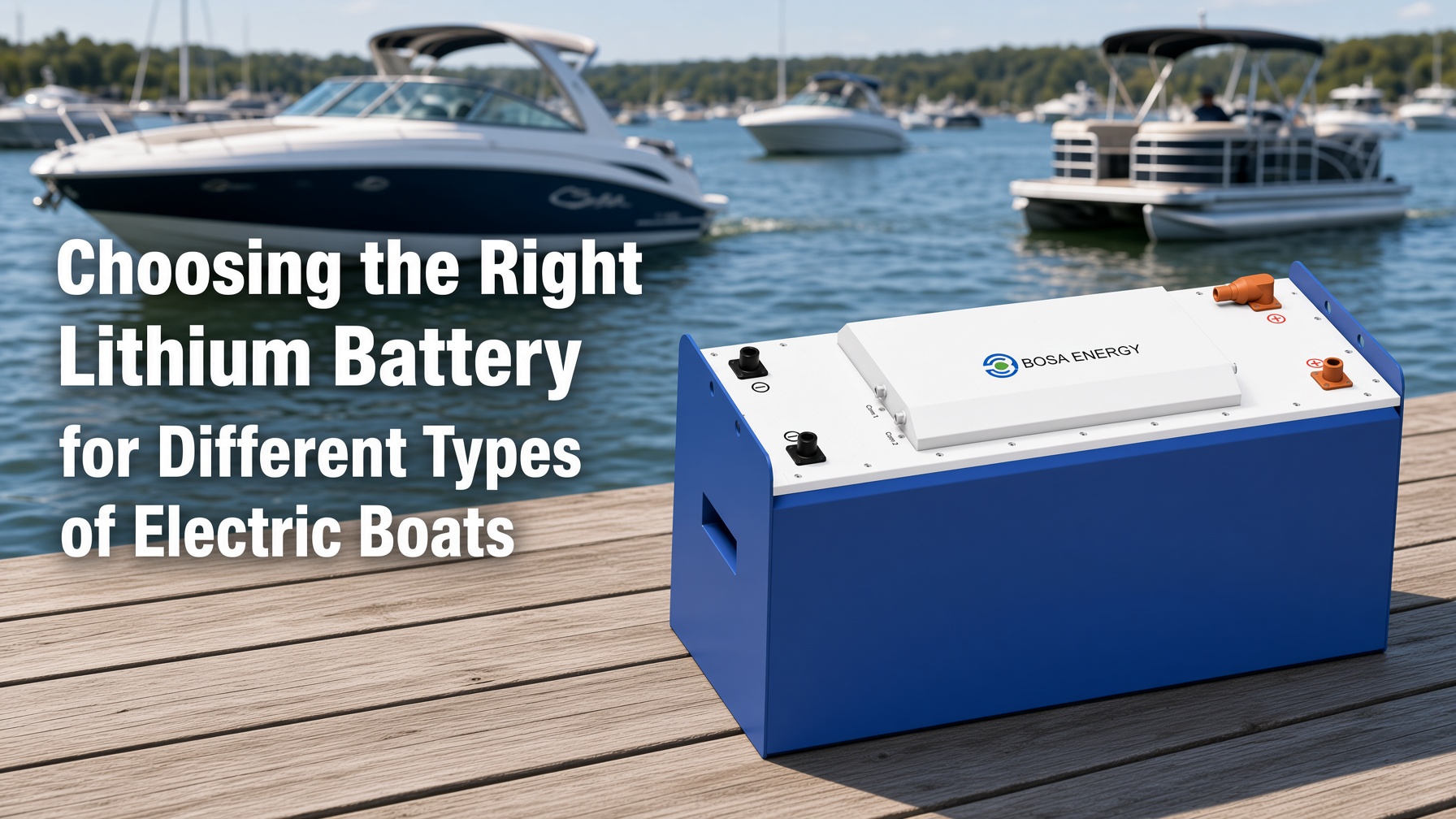
Selecting the correct energy storage system is the single most important decision when specifying or converting an electric boat. Choosing the Right Lithium Battery for Different Types of Electric Boats requires matching chemistry, voltage, capacity, protection rating and certification to the vessel’s size, duty cycle and operating environment. Lithium iron phosphate (LiFePO₄ / LFP) has become the dominant chemistry for most marine applications in 2026 because of its thermal stability, long cycle life and high usable capacity.
This technical briefing provides a decision framework for recreational day boats, pontoons, fishing vessels, hydrofoil craft and commercial workboats. It prioritises measurable metrics, current standards and practical selection criteria so fleet managers, yacht designers and owners can make data-driven choices.
Why LiFePO₄ Dominates Marine Propulsion and House Banks
Compared with lead-acid and higher-energy-density chemistries such as NMC:
| Metric | Lead-Acid / AGM | NMC | LiFePO₄ (LFP) |
|---|---|---|---|
| Cycle life to 80 % capacity | 300–600 | 500–1,500 | 3,500–5,000+ |
| Usable capacity (DoD) | 50 % | 80–90 % | 80–100 % |
| Thermal runaway onset | N/A (different failure mode) | ~150–200 °C | ~270 °C |
| Weight (100 Ah 12 V equivalent) | 28–32 kg | ~10–12 kg | 12–14 kg |
| Self-discharge / month | 3–15 % | 3–5 % | <3 % |
| Typical marine lifespan | 2–4 χρόνια | 4–7 years | 8–12+ years |
LFP delivers the best combination of safety, longevity and total cost of ownership for the majority of electric boats operating in saltwater or freshwater environments. High-voltage NMC packs still appear in some performance hydrofoils, but LFP remains the default recommendation for new installations.
Battery Requirements by Electric Boat Type
Different vessel classes impose different constraints on energy capacity, voltage, weight distribution and environmental protection. The table below summarises typical 2026 specifications.
| Boat Type | Typical Motor Power | Preferred Voltage | Energy Capacity Range | Key Priorities | Example Systems |
|---|---|---|---|---|---|
| Small recreational / kayak / RIB day boat | 1–6 kW | 24–48 V | 1–8 kWh | Lightweight, IP67, drop-in or integrated | ePropulsion Spirit / Navy, Torqeedo Travel / Cruise |
| Pontoon / leisure cruiser | 5–15 kW | 48–72 V | 15–30 kWh | Usable capacity, house-bank integration, opportunity charging | Custom 48/72 V LFP packs |
| Fishing / centre-console | 3–10 kW + electronics | 36–48 V | 10–20 kWh | Vibration resistance, stable voltage for electronics, deep-cycle | 48 V LFP with robust BMS |
| Hydrofoil / high-performance (e.g. Candela C-8) | 45–50 kW | 300–400 V | 60–80 kWh | High energy density, fast DC charging, precise SOC management | Candela / Polestar 69 kWh pack |
| Commercial workboat / ferry tender | 15–40 kW continuous | 48–96 V or higher | 40–100+ kWh | Cycle life ≥3,500, telematics, IP67, classification society approval | Torqeedo Deep Blue Battery 80 (79.2 kWh), ePropulsion G-Series 96 V |
Choosing the Right Lithium Battery for Different Types of Electric Boats therefore starts with an accurate definition of continuous and peak power, required runtime at cruise speed, and expected daily energy throughput.
Core Selection Criteria
1. Capacity Sizing (kWh)
Use the practical formula:
$$
\text{Required kWh} = \frac{\text{Average power draw (kW)} \times \text{Desired runtime (h)}}{\text{Usable DoD}}
$$
Add a 20–25 % reserve for wind, current, aging and hotel loads. For LFP, usable DoD is typically 70–80 % when a 20 % minimum state of charge (SOC) floor is observed. Example: 6 kW average draw for 3 hours at 75 % usable DoD requires approximately 24 kWh of nameplate capacity.
Keep daily opportunity charges in the 15–40 % capacity range and avoid routine discharges below 20–30 % SOC. This operating window maximises cycle life.
2. Voltage Architecture
- ≤8 kW continuous → 24 V or 48 V acceptable
- 8 kW continuous → minimum 48 V; 72–96 V preferred to reduce cable cross-section and heat
- High-performance hydrofoils → 300–400 V class systems
Higher voltage lowers current for a given power, reducing conductor size, voltage drop and connection losses.
3. Chemistry and Cell Format
LiFePO₄ prismatic or pouch cells with integrated or external BMS. Prefer cells and packs that meet IEC 62619 (safety) and IEC 62620 (performance). Avoid consumer-grade drop-ins that lack marine-grade BMS or proper thermal management.
4. Environmental Protection and Mechanical Design
- Minimum IP65; IP67 preferred for exposed or bilge-adjacent locations
- Secure mounting that limits movement under vessel motion
- Corrosion-resistant terminals and busbars
- Thermal management (passive or liquid) for packs >20 kWh or tropical service
5. Certifications and Standards Compliance
- ISO 23625:2025 – Small craft – Lithium-ion batteries (applies to systems >500 Wh; requires IEC 62619 / IEC 62620 compliance)
- ABYC E-13 – Lithium-Ion Batteries (installation, BMS, disconnect requirements; 2025 updates emphasise direct remote-switch interruption of contactor power)
- ISO 16315 – Electric propulsion systems
- UN 38.3 transport certification
- For commercial vessels: classification society type approval (DNV, ABS, Lloyd’s, etc.)
Any pack intended for propulsion or large house banks should carry documentation demonstrating compliance with these standards.
6. Battery Management System (BMS)
Mandatory features under ABYC E-13 and ISO 23625:
- Cell-level voltage, temperature and current monitoring
- Hard disconnect for over-voltage, under-voltage, over-current and over-temperature
- Pre-charge circuit
- Accurate coulomb-counting SOC (flat LFP voltage curve makes voltage-only SOC unreliable)
- Communication (CAN, Bluetooth or Modbus) for vessel monitoring systems
Charging and Operational Best Practices
- Use lithium-specific chargers with correct voltage set-points (typically 3.45–3.55 V/cell absorption for longevity)
- Opportunity charging of 15–40 % capacity during short stops is encouraged and does not harm LFP
- Maintain SOC between 20–30 % minimum and 80–90 % maximum for daily cycling
- Store long-term at 40–60 % SOC
- Enable low-temperature charge inhibit (<5 °C) to prevent lithium plating
These practices routinely deliver ≥3,500 cycles at 80 % depth of discharge under real marine conditions. Torqeedo’s Deep Blue Battery 80, for example, is rated for at least 3,750 cycles at 80 % DoD (or 4,000 cycles at 75 % DoD) at 25 °C.
Decision Framework for Selection
- Define daily energy demand (propulsion + house loads) and peak power.
- Select voltage architecture that keeps continuous current practical.
- Size nameplate capacity for required runtime plus 20–25 % reserve while respecting 20–30 % SOC floor.
- Specify LFP chemistry with marine-grade BMS and IP67 enclosure.
- Confirm compliance with ISO 23625:2025 and ABYC E-13.
- Verify charger, alternator (if hybrid) and cable sizing compatibility.
- Require telematics or SOC display for ongoing monitoring.
- Evaluate total cost of ownership over 8–12 years rather than upfront price alone.
Following this sequence ensures Choosing the Right Lithium Battery for Different Types of Electric Boats produces a system that is safe, efficient and durable.
Practical Checklist
- Motor continuous and peak power documented
- Required cruise runtime and daily energy throughput calculated
- Voltage class matched to power level
- Nameplate kWh sized with 20–25 % reserve
- LiFePO₄ chemistry specified
- BMS with hard disconnect and coulomb counting
- IP67 (or higher) enclosure
- ISO 23625:2025 / ABYC E-13 compliance documentation
- Compatible lithium charger and opportunity-charging capability
- Mounting, ventilation and over-current protection designed per standards
- SOC operating window 20–80 % programmed or recommended
Συχνές ερωτήσεις
What is the most common mistake when sizing electric boat batteries? Underestimating hotel loads and real-world hydrodynamic losses, then omitting the 20–25 % reserve. Always calculate from measured or realistic average power draw.
Is NMC ever preferable to LFP on boats? Only when absolute energy density is critical (certain high-performance hydrofoils such as the Candela C-8) and additional thermal safeguards are engineered. For the vast majority of applications, LFP is safer and longer-lived.
How important is ISO 23625:2025? It is the primary international standard governing selection and installation of lithium-ion batteries on small craft. Compliance demonstrates that cells meet IEC 62619/62620 and that installation addresses venting, audible alarms, EMC and safety philosophy.
Can I use automotive or RV lithium batteries on a boat? Generally no. Marine packs require specific BMS behaviour, vibration resistance, corrosion protection and certification pathways that automotive/RV products usually lack.
What cycle life can I realistically expect? Properly managed LFP packs routinely achieve 3,500–5,000 cycles to 80 % remaining capacity when operated within the 20–80 % SOC window and charged with lithium-compatible equipment. Commercial systems such as Torqeedo Deep Blue publish ≥3,750 cycles at 80 % DoD under stated conditions.
Authoritative References
- ISO 23625:2025 – Small craft — Lithium-ion batteries (first edition, March 2025; requires IEC 62619 / IEC 62620)
- ABYC E-13 – Lithium Ion Batteries (selection, installation and system design for systems >500 Wh; 2025 updates)
- Candela C-8 technical specifications (69 kWh pack, 57 nm range at 22 kn)
- Torqeedo Deep Blue Battery technology (LFP, IP67, ≥3,750 cycles @ 80 % DoD, Deep Blue Battery 80 at 79.2 kWh)
- ePropulsion G-Series Batteries (96 V LFP systems for 10–40 kW motors)
- IEC 62619 and IEC 62620 – Secondary lithium cells and batteries for industrial applications
- BoatUS – The Latest On Lithium Batteries (ABYC E-13 context)
Choosing the Right Lithium Battery for Different Types of Electric Boats ultimately reduces to matching verified performance data, standards compliance and operational discipline to the specific vessel class. When these elements align, modern LFP systems deliver quiet, emission-free propulsion with predictable range and multi-year service life.