
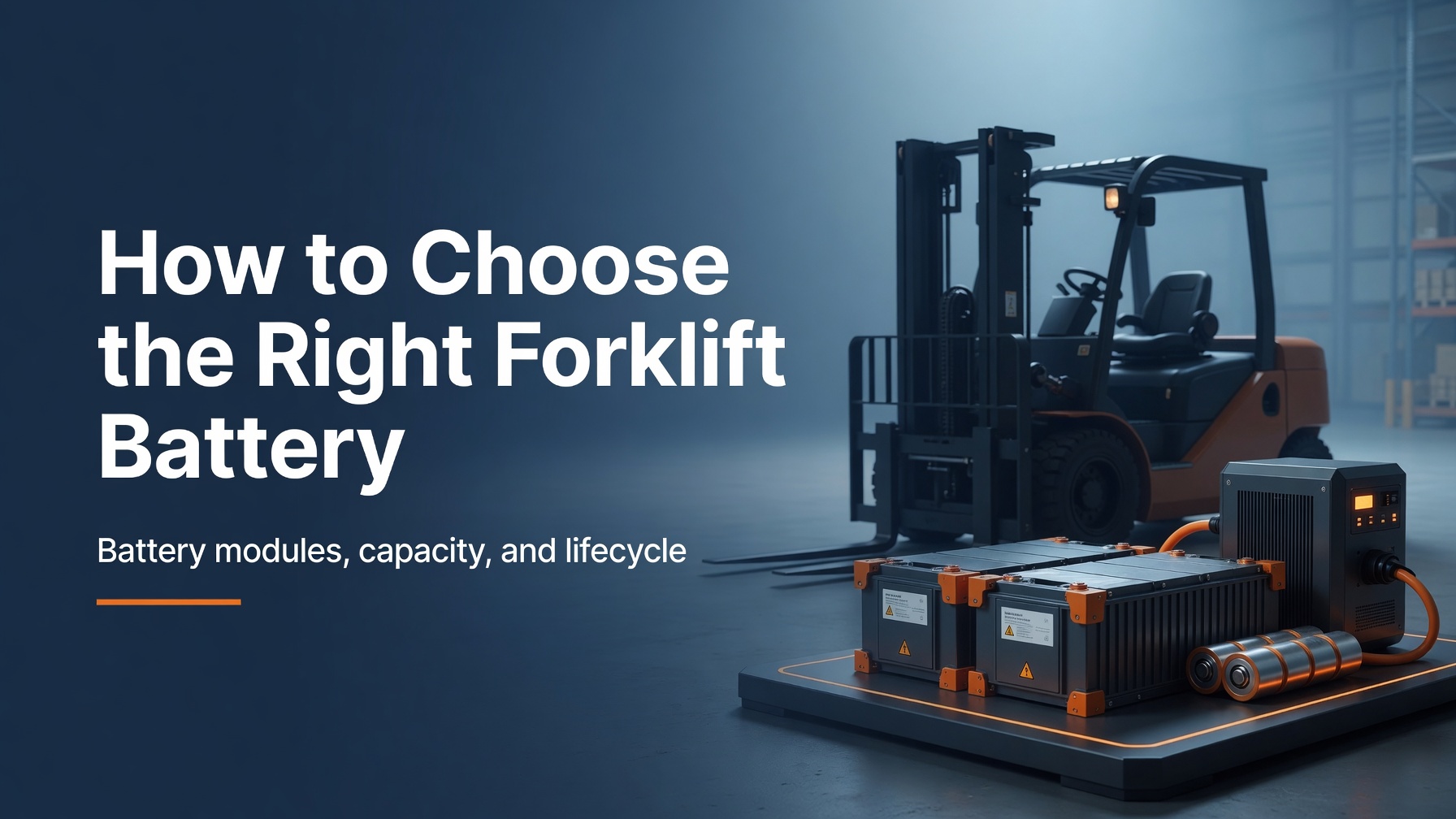
Choosing the right forklift battery is one of the most critical decisions warehouse managers, fleet operators, and logistics professionals make. The battery powers your entire material handling operation — directly affecting uptime, productivity, safety, maintenance costs, and long-term profitability.
In this comprehensive 2026 guide, we explain exactly how to choose the right forklift battery for your specific needs. Whether you operate single-shift facilities or demanding multi-shift warehouses, this expert breakdown covers battery technologies, sizing, total cost of ownership (TCO), and the key factors that separate good decisions from costly mistakes.
Why Choosing the Right Forklift Battery Matters
A poorly matched battery leads to frequent downtime, excessive maintenance labor, safety risks, and inflated operating costs. In high-utilization environments, battery-related issues can cost thousands of dollars per hour in lost productivity.
Modern warehouses face additional pressures: labor shortages, rising energy costs, stricter environmental regulations, and the push toward 24/7 operations. Selecting the optimal battery technology helps you maximize fleet efficiency while controlling hidden expenses that often exceed the initial purchase price.
Step 1: Assess Your Forklift and Operational Requirements
Before comparing battery types, gather accurate data about your equipment and usage patterns.
Voltage, Capacity, and Physical Specifications
Match the battery voltage exactly to your forklift’s nameplate (common options: 24V, 36V, 48V, or 80V). Using the wrong voltage can damage equipment or create safety hazards.
Capacity (measured in Ah or kWh) depends on:
- Average hourly energy consumption
- Shift length and number of shifts per day
- Desired runtime between charges
Physical fit is non-negotiable. Measure the battery compartment length × width × height precisely. Weight also matters — lithium batteries are often lighter than equivalent lead-acid units. Installing a lighter battery without adding certified ballast can violate OSHA stability requirements and reduce the forklift’s rated capacity.
Duty Cycle and Usage Patterns
- Single-shift, low-intensity operations — Traditional lead-acid batteries often perform adequately.
- Multi-shift or high-utilization fleets — Lithium-ion batteries deliver clear advantages through fast charging and opportunity charging (topping up during breaks without damaging the battery).
Operating Environment
Consider temperature extremes, dust, moisture, and indoor air-quality regulations. Lead-acid batteries release hydrogen gas during charging and require dedicated ventilation. Lithium-ion batteries produce no gassing and operate reliably across wider temperature ranges when equipped with proper thermal management.
Step 2: Lead-Acid vs Lithium-Ion Forklift Batteries — Head-to-Head Comparison
The two dominant technologies are lead-acid and lithium-ion (primarily LiFePO4 chemistry for industrial motive power). Here’s how they compare on the metrics that matter most:
Key Performance Differences (Industry Consensus + Advanced LiFePO4 Data):
- Κύκλος ζωής: Lead-acid typically delivers 1,000–1,800 cycles. Quality LiFePO4 batteries exceed 3,000–3,500+ cycles under proper conditions.
- Χρόνος φόρτισης: Lead-acid requires 8–10+ hours (plus cooling time). Advanced lithium solutions fully charge in 1–4 hours and support opportunity charging.
- Συντήρηση: Lead-acid demands regular watering, cleaning, and equalization. Lithium-ion is virtually maintenance-free.
- Ασφάλεια: Lead-acid carries risks of acid spills, corrosion, and hydrogen gas buildup. LiFePO4 offers stable chemistry with multi-level BMS protection, over/under-voltage safeguards, temperature monitoring, and no thermal runaway risk under normal use.
- Energy Efficiency: Lead-acid ~80%. Lithium-ion 95–98%, translating to meaningful electricity savings.
- Διάρκεια ζωής: Lead-acid: 3–5 years. Lithium-ion: 8–12+ years depending on usage and management.
- Συνολικό Κόστος Ιδιοκτησίας: Lead-acid has lower upfront cost but significantly higher long-term expenses. Lithium typically delivers 30–60% lower TCO over 5–10 years.
Advanced LiFePO4 batteries (such as those engineered for demanding industrial applications) further emphasize fast 1–2 hour charging, maintenance-free operation, up to 70% lower ownership costs versus lead-acid in intensive use, and eco-friendly profiles with no hazardous acid handling.
Step 3: Calculate True Total Cost of Ownership (TCO)
Never decide based on purchase price alone. A proper TCO analysis includes:
- Initial battery + charger + installation costs
- Daily/weekly maintenance labor (often 15–30 minutes per lead-acid battery)
- Energy consumption differences
- Replacement frequency and associated downtime/labor
- Safety and compliance expenses
- End-of-life recycling or disposal costs
Real-world fleet data consistently shows lithium-ion batteries paying for themselves in 2–4 years under multi-shift conditions, with substantial cumulative savings thereafter through fewer replacements, zero watering labor, higher uptime, and lower energy use.
Step 4: Correctly Size Your Forklift Battery
Follow these practical steps:
- Review the forklift manufacturer’s recommended battery specifications.
- Estimate daily energy demand: Average kW draw × operating hours (add 10–20% safety factor).
- Apply realistic Depth of Discharge (DoD): Lead-acid typically 50–80% usable; lithium 80–100%.
- Convert to required Ah/kWh and verify physical fit and weight.
- Factor in available charging windows and whether opportunity charging is feasible.
When in doubt, consult your forklift OEM or a qualified battery specialist — undersizing leads to excessive cycling and premature failure, while oversizing wastes capital.
Step 5: Evaluate Advanced Features, Safety, and Support
Premium lithium batteries include sophisticated Battery Management Systems (BMS) with:
- Real-time cell monitoring and balancing
- CAN/RS485 communication for integration with chargers and fleet management systems
- Smart platforms offering GPS tracking, remote monitoring, data analytics, over-the-air updates, and electronic geofencing
Look for robust warranties (5+ years common on quality lithium packs), strong after-sales support, and relevant certifications (UL, CE, UN38.3). Charger compatibility is equally important — many lithium solutions work with existing infrastructure but perform best with purpose-designed smart chargers.
Common Mistakes to Avoid When Choosing a Forklift Battery
- Focusing only on the lowest upfront price
- Ignoring actual duty cycle and charging windows
- Neglecting physical dimensions and weight requirements
- Underestimating maintenance labor and downtime costs
- Failing to plan for future increases in shifts or utilization
- Choosing a battery without verifying charger and forklift compatibility
When Lithium Forklift Batteries Deliver the Best ROI
Lithium-ion (especially LiFePO4) is usually the superior choice when you have:
- Multi-shift or high daily operating hours
- Limited time between shifts for charging
- High labor costs or limited maintenance staff
- Indoor operations where ventilation and acid handling are concerns
- Long-term fleet planning (5+ years)
- Sustainability or efficiency targets
Lead-acid remains viable for very low-intensity, single-shift operations with tight capital budgets and existing optimized charging infrastructure.
Σύναψη
Choosing the right forklift battery requires balancing upfront cost against long-term performance, safety, and total ownership expenses. In 2026, lithium-ion technology — particularly advanced LiFePO4 solutions — offers compelling advantages for most modern warehouse and logistics operations through dramatically longer cycle life, fast and flexible charging, zero maintenance, superior safety, and significantly lower TCO.
Start by auditing your current fleet’s battery performance, shift patterns, and true operating costs. Then work with experienced suppliers who can match the ideal voltage, capacity, and feature set to your specific forklifts and workflows.
The right battery decision today translates directly into higher productivity, lower costs, and a safer workplace for years to come.
Frequently Asked Questions About Forklift Batteries
How long do forklift batteries typically last? Lead-acid batteries usually last 3–5 years or 1,000–1,800 cycles. Quality lithium-ion (LiFePO4) batteries deliver 8–12+ years and 3,000–5,000+ cycles with proper management.
Can I replace a lead-acid forklift battery with lithium? Yes — many lithium batteries are designed as drop-in replacements. Confirm exact dimensions, weight (or add ballast if needed), connector type, and charger compatibility. Some fleets also upgrade chargers for optimal performance.
Is lithium safe for use in forklifts? LiFePO4 is one of the safest lithium chemistries. It includes multiple layers of protection via the BMS and does not release hydrogen gas or risk acid spills.
What is the best forklift battery for multi-shift operations? Lithium-ion with fast-charging capability and opportunity-charging support. It eliminates the need for battery swapping and maximizes uptime.
How do I calculate the right battery capacity? Estimate daily kWh demand based on average power draw and operating hours, then adjust for usable DoD and efficiency. Add a safety margin and verify against your forklift’s specifications.
Does lithium require special chargers? While many lithium batteries can use existing chargers, dedicated lithium chargers or smart chargers with proper CC/CV profiles deliver the best results and longest life.
Ready to optimize your forklift fleet? Begin with a detailed battery and usage assessment — the data-driven path to lower costs and higher reliability starts here.